

First Impressions Happen Before Your Website

Governing the full search ecosystem
On a quiet Wednesday morning, a managing partner noticed something subtle. The firm’s rankings had not moved. Traffic held steady. Advertising spend was unchanged.
Yet the calls felt different.
Prospective clients arrived informed, sometimes pre-briefed, occasionally referencing explanations that did not originate on the firm’s website at all. They had read reviews. They had checked the firm's Google Business Profile. They had scanned directory listings. Some had asked an AI assistant to summarize the issue before making contact.
The firm had not disappeared from search. Search had changed shape.
For much of the past two decades, legal marketing treated search as a singular pipeline. A query produced a ranked list. A ranking produced traffic. Traffic produced enquiries.
That linear sequence no longer reflects how discovery actually unfolds.
A legal search ecosystem is the network of trust surfaces that collectively shape client perception before contact ever occurs.
Website, Google Business Profile, paid search, legal directories, reviews, referrals. These surfaces do not operate independently. They interact. Each reinforces or weakens the others. Visibility no longer moves from query to call in a straight line. It circulates.
The Ranking Pipeline Is Broken
The traditional framework divided marketing into channels. SEO in one column. Paid advertising in another. Directories maintained periodically. Reviews handled reactively. Referrals considered offline.
Each surface was optimized in isolation.
That separation once made sense. When search behavior was primarily link-driven and websites were the primary evaluation surface, strong rankings often translated directly into new matters.
Today, clients rarely evaluate a firm on a single surface.
A referral often triggers a verification search. The Google Business Profile is reviewed before the website. Reviews are scanned before practice pages are read. A directory listing confirms legitimacy. A paid advertisement reinforces positioning rather than introducing it.
The decision emerges from their relationship.
Modern Discovery Is Multi-Surface
Modern search systems evaluate firms as entities, not pages. They reconcile structured data, review language, geographic signals, and third-party citations to determine whether a firm presents a coherent professional identity.
Clients do something similar, though less formally. They triangulate.
If the website emphasizes family law but directory listings highlight general practice, uncertainty appears. If paid campaigns promote services not reflected in substantive content, confidence erodes. If reviews reference matters the firm no longer wishes to emphasize, perception drifts.
These are not technical failures. They are alignment failures.
Search systems reward signal convergence. Clients reward clarity.
Why This Matters for Canadian Law Firms
Canadian law firms operate within strict professional rules. Law societies prohibit misleading claims, exaggerated language, and implied guarantees. Precision is not optional. It is regulatory.
In this environment, consistency across surfaces becomes structural credibility. When messaging diverges between website, Business Profile, advertising, and directories, the issue is not aesthetic. It is professional.
Compliance, in other words, aligns naturally with ecosystem coherence. Factual, jurisdiction-specific, clearly structured content is more easily interpreted by search systems and more readily trusted by clients.
Visibility Happens Upstream of Traffic
Despite this shift, many firms continue to measure performance as though discovery were linear. Rankings are tracked. Traffic is monitored. Advertising impressions are reviewed.
Yet few firms can answer a more consequential question.
Which visibility surface produces the most qualified enquiries?
Digital analytics, for all their sophistication, cannot fully resolve this. They do not reliably capture verification searches following referrals. They do not measure how often a Business Profile shaped perception without a website visit. They do not reflect whether AI-generated summaries accurately represent the firm.
Visibility increasingly occurs upstream of traffic.
Measurement must move closer to intake.
Intake Intelligence Starts With Structured Logging
If ecosystem alignment is the strategic objective, intake intelligence is the operational beginning.
Intake intelligence is the structured practice of recording how each enquiry originates and assessing its quality over time. It replaces surface-level marketing metrics with business-level insight.
To make this practical, we have prepared a structured intake framework designed specifically for law firms. It is delivered as a Google Sheets template that you can copy directly into your own Drive.
The solution is not another dashboard. It is disciplined intake.
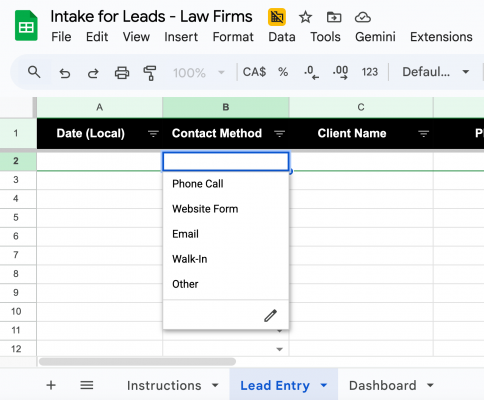
Example view of the Intake Intelligence dashboard.
The Intake Intelligence Framework
What the framework includes
- A structured Intake Log for recording every enquiry
- Standardized lead source categories aligned to ecosystem surfaces
- Practice area and geographic tracking fields
- Lead quality assessment fields
- An automated dashboard that updates as data is entered
How it works
- Click the link above
- Select “Make a copy” when prompted by Google
- Your private version saves directly to your Drive
- Begin logging enquiries immediately in the Intake Log tab
Over time, patterns emerge. Some surfaces generate volume but little strategic alignment. Others produce fewer enquiries but stronger matters. Messaging drift becomes visible. Geographic misalignment surfaces. Referral influence becomes measurable rather than assumed.
This is not technical optimisation. It is governance.
It is also the first operational step toward ecosystem alignment.
Durable Visibility Is Systemic
Much discussion in legal marketing focuses on algorithm updates, artificial intelligence, or advertising costs. These forces matter. They are external variables.
Ecosystem coherence is internal.
Firms that coordinate identity across website, Business Profile, paid campaigns, directories, reviews, and referrals reduce friction in discovery. They strengthen clarity before a consultation occurs. They improve conversion not because of a single tactic, but because the system communicates stability.
Search has not disappeared. It has matured into an integrated environment where signals interact continuously.
Visibility is circular, not linear.
Law firms that treat search as a disconnected channel will continue optimising fragments. Firms that govern it as an ecosystem will build durable authority over time.
In a market where clients evaluate counsel across multiple surfaces before making contact, coherence is competitive advantage.
References
| Source | Link |
|---|---|
| TIDAL Digital — “Search Isn’t a Channel — It’s an Ecosystem” | tidaldigital.co.uk/search-discovery-whitepaper |
| AmICited — AI Search Visibility: New Metrics Beyond Ranking | amicited.com/blog/ai-search-visibility |
| AmICited — “AI Visibility Ecosystem” Definition | amicited.com/glossary/ai-visibility-ecosystem |
| Search Engine Journal — SEO, AEO & GEO in the Age of AI | searchenginejournal.com/geo-generative-engine-optimization/ |
| SparkToro & Datos — Zero-Click Search Study | sparktoro.com/blog/zero-click-search-study-2024/ |
Note: Platform capabilities, AI visibility models, and measurement frameworks evolve rapidly. Firms should review current research and professional guidance regularly.